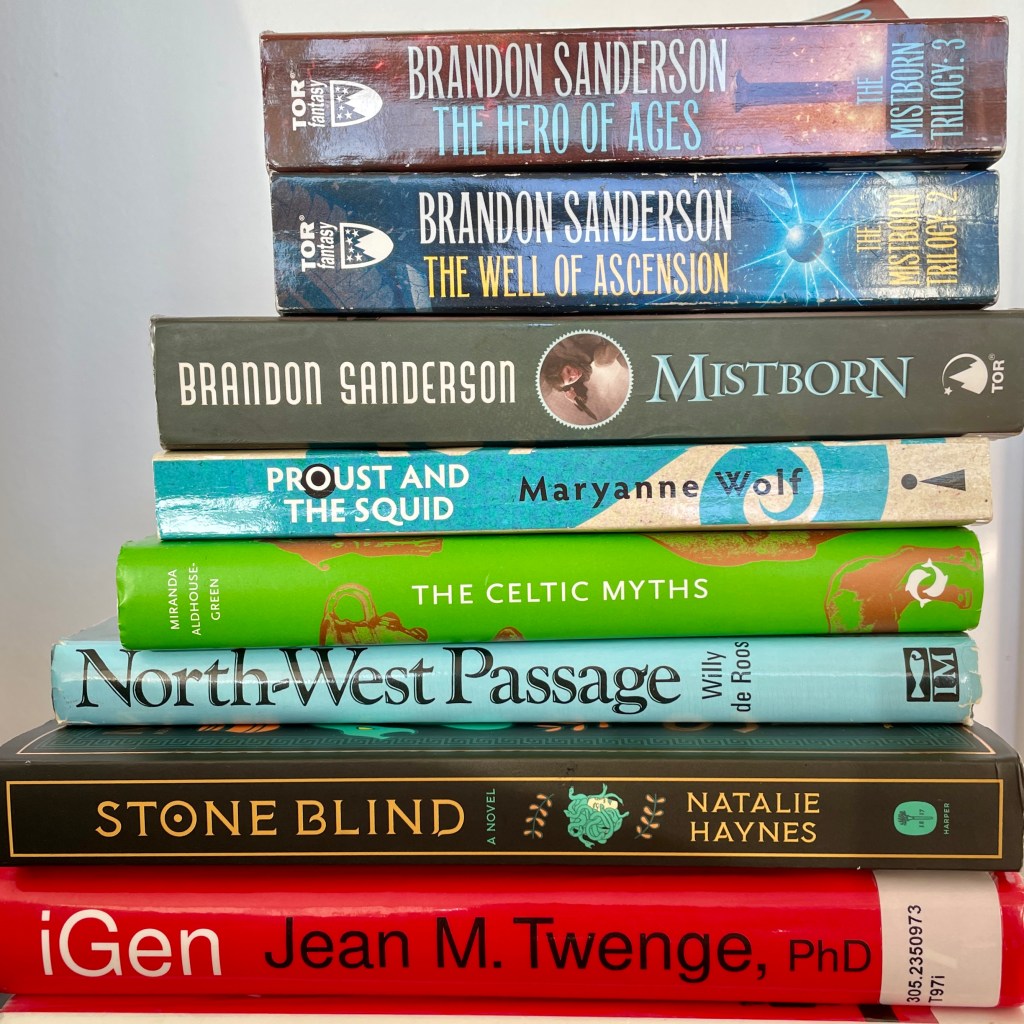
I finished 18 books in the first three months of 2023. If that sounds like a lot, remember that I’m the kind of dork who takes books to the lunchroom, doesn’t own a TV, and visits bookstores on vacation.
I don’t plan to review books on this blog. I’m a fiction writer, not a book reviewer, and I would prefer not to begin my writing career by trashing my peers’ books.
But I still want to write about books! And so my plan, going forward, is to publish a quarterly update on my noteworthy reading. Instead of listing everything, I’ve picked a few books that I’m still thinking about, even after I put them down. I hope hearing about my reading adventures will inspire some of your own.
Fiction
The Mistborn Trilogy, Brandon Sanderson
Somehow, it took me until 2022 to read any of Sanderson’s work, and until 2023 to finish this trilogy. Mistborn is an epic fantasy set in the bleak Final Empire, where ash rains from the skies and a tyrannical ruler enslaves most of the population. In the first book, a young girl with a powerful gift joins a team of thieves fighting to overthrow the Lord Ruler. In the sequels, the thieves and their allies struggle to govern in the aftermath—and fight the evil the Lord Ruler kept at bay. The trilogy features a sprawling cast of thieves, nobles, and scholars, and a detailed magic system based on metals. Sanderson’s world-building expands as each book in the trilogy fills in questions left by earlier instalments.
Stone Blind, Natalie Haynes
As a mythology nerd, I love a good retelling. Haynes takes on the myth of Medusa and Perseus by humanizing Medusa and making you wish Perseus had just looked Medusa in the eye, or honestly just stayed home. Like Haynes’ previous novel, A Thousand Ships, Stone Blind incorporates many points of view, from gods to Gorgons, snakes to mortals. And it’s clear whose side Haynes is on: the women who had the misfortune to attract the gods’ attention.
Non-Fiction
iGen: Why Today’s Super-Connected Kids are Growing Up Less Rebellious, More Tolerant, Less Happy—and Completely Unprepared for Adulthood, Jean M. Twenge, PhD
Twenge draws on survey data and interviews to paint a portrait of the cohort she calls the “Internet Generation”, or “iGen” (more commonly known as “Gen Z”). Americans born from 1995 to 2012, she says, grew up safer, less independent, and more online than any previous modern generation.
Ironically, safety and connection haven’t made them happier: instead, anxiety, depression, and loneliness have increased significantly since 2012, the year that smartphone use became ubiquitous. Twenge’s statistics showed increases not only in self-reported symptoms of mental health problems but also in more objective measures like rates of self-harm. The survey data also showed Gen Z teens spent much of their leisure time on activities correlated with poor mental health (like social media and other screen time). Meanwhile, they spent less time on activities associated with good mental health (like exercise, print media, and in-person socializing) than Millennials or Gen X did at the same age.
Twenge’s book is limited to US data and was published in 2018, so the data doesn’t include the effects of the COVID-19 pandemic. However, she has included updated data in her upcoming book Generations: The Real Differences Between Gen Z, Millennials, Gen X, Boomers, and Silents (which I haven’t read yet), and in this article on the After Babel Substack.
North-West Passage, Willy de Roos
In 1977, Willy de Roos sailed from Greenland to Vancouver via Canada’s Northwest Passage. His ship, Williwaw, was only the third ship ever to complete the passage, and the first sailing ship since Roald Amundsen’s Gjøa in the 1900s.
The book, published in English in 1980, is a tale of adventure in a vanished world. The Arctic navigator’s nemesis is the sea ice that persists even through the summer, blocking channels and trapping ships. De Roos rams through it, he races around it, and, when necessary, he hides from it. The Northwest Passage was, in the 1970s, never entirely free of ice. The ice pack posed an ever-present threat and created a strict deadline for de Roos’ journey: round Point Barrow, Alaska, by mid-September, or winter in the Arctic.
Although some of de Roos’ comments about women and the Inuit are outdated and offensive, the book is fascinating as a historical account. Less than fifty years ago, the Northwest Passage was so difficult that only three ships had ever completed it. Because of climate change, tourist vessels now navigate the remote channels where de Roos encountered impenetrable pack ice. I couldn’t help but feel a bit of grief knowing how much the Arctic has changed, even though I’ve never been there.
This book has likely been out of print for some time—I picked up my copy at a used bookstore in Victoria. If you want to read it, you may need to go on your own adventure to find it.
Proust and the Squid: The Story and Science of the Reading Brain, Maryanne Wolf
Reading is unnatural. We did not evolve to read. Instead, when we read, our brain harnesses systems that evolved for other purposes. Wolf, a professor of child development with expertise in reading and language, explains how humans first learned to read, how children learn to read today, and what happens when a child cannot learn to read.
Proust and the Squid is a fascinating, though sometimes technical, journey into reading. She illuminates a process that, for skilled adult readers, is both automatic and unnoticed. Wolf assumes the reader has no specialist knowledge of psychology, linguistics, or neuroscience. She explains the concepts she relies on, but a reader without a scientific background will need to spend time with her definitions and diagrams to gain a fuller understanding.
The most eye-opening part of the book was her discussion of dyslexia and other reading-related disabilities. Drawing on the research in these fields, she moves beyond surface-level pop culture explanations to look at how dyslexic people process written language differently. Ultimately, her conclusion is hopeful: most children who struggle to read can learn with interventions that target their specific challenges.
What’s next?
Some plans in the works right now, in order of when you may see them or hear about them:
- An email mailing list
- A prequel short story set in the Shadowmage universe and available to email list subscribers
- Other projects beyond the world of Shadowmage – these you may not hear about for a while, they are very early days
 Allison Render - Fantasy Writer
Leave a comment